Showing posts with label audio. Show all posts

Tuesday, 26 May 2020

The changing face of worship; how the Covid -19 pandemic may help to expand church congregations

We have moved this content to and added more content on our new website:

www.cga-integration.co.uk


The Covid-19 pandemic has had a far reaching impact on every aspect of society, and how we worship is no different.  Gathering every Sunday at church to share a service with other members of our congregation may no longer be possible, but this does not mean that communal worship has ceased.  Churches across the land have moved online.  The traditional weekly gathering has been replaced with online services, webstreams and Zoom calls.  Although this has happened through necessity, we must embrace the opportunity that this situation has presented us with and capitalise on the new technological proficiency that we have developed in our local church communities.

Moving forward, as we are permitted to open up our churches and buildings for worship, there will be hesitation from certain members of the parish.  Not everyone will be keen or able to rush back to a shared public space for their regular worship.  As such, there will still be a role for broadcasting weekly online services, to ensure that everyone in the community continues to be provided for.  But this should not be seen as a hindrance.  In fact, in addition to regular parishioners watching online, there is also a new group of people who have found the church during this pandemic.  A group of people who like the accessibility of ‘church at home’ and online services.  Some may well be watching on ‘catch up’ at a different time or even on a different day to the usual Sunday service.  Services online have actually grown the size of regular weekly congregations.

As we gradually move back into our churches, I think we need to develop a ‘new normal’ to include those people who for whatever reason are not with us for our weekly service in person. These may include people in care homes or elderly members of the parish who are no longer confident or able to travel to church.  Couples who do not feel comfortable bringing their baby or young child to church or leaving them in the creche or at Sunday school, who find it less stressful to enjoy the service at home.  Past members of the congregation who have moved away but appreciate the opportunity of familiar Sunday worship with old friends.  New online members who may be geographically distant but who are drawn to your style of worship or those who are local but just enjoy the flexibility of worship ‘on demand.’

Worship leaders need to think about how they can include this new remote congregation in their main services.  Laptop microphones are not good enough to pick up sound from the whole church.  A digital sound processor is needed to connect the existing sound system and microphones being used in the church service to ensure that sound can be clearly transmitted from both the spoken word; readings, prayers and sermons, through to musical worship; communal hymns, choirs and music groups. In addition, a motorised and zoomable digital camera will be needed to effectively record and transmit all aspects of the service for the remote congregation.

This might mean having a camera operator during the Sunday service, ensuring that the right image is shown at the right time or words for hymns are visible on screen.  Camera angles will need to be considered as we think about individuals' privacy as well as young and vulnerable members of the congregation who may attend a service, but who should not be broadcast on a web stream or call to unknown end-users.  These restrictions may dictate the need for prerecorded services rather than a live stream, giving you a chance to review and edit the service and send it out a few hours later.  Thought will also need to be given to communicating how members of the virtual congregation will be notified about and view the services and possibly who the link is sent to to enable a remote connection.

The good news is that a lot of these questions have already been broached during the pandemic and you already have a lot of the tools you need to make this happen.  The same processes which enable the interfacing to the web or Zoom stream which you are already using during lockdown can still be used.

The hardware required to link your sound system and connect your church to the recording stream is an investment and possibly more than had been planned and budgeted for at this time.  If you are not already active in this area, grants are available from church bodies to help you to set up online during this period of social distancing.

By taking the step to invest in a digital sound processor to enable the interfacing to the web or Zoom to effectively stream services will have the added benefit of improving the sound quality within the existing church sound system and through the induction loop, so the sound for all worshippers, wherever they are joining you from, will be the best that it can be.

CGA Integration … Making hospitality sound great!

Wednesday, 3 April 2019

Size is not everything!

We have moved this content to and added more content on our new website:

www.cga-integration.co.uk


“Wow look at that speaker! We’re not a nightclub!!!”

I have heard this and similar comments time and again when designing a sound
system for a client for the first time.  A regular misconception is that the physical
size of a speaker is directly proportional to the volume or loudness of the sound
system, but that is generally not the case.

It’s true that you will need larger speakers to produce sound for a live concert
than you would need to install in a restaurant, but as sound gets quieter, there
is a minimum speaker size that you will reach, after which you start
compromising on sound quality.

Sound reproduction is all about moving air particles or vibrations.  In a
loudspeaker an electromagnet is attached to a cone which amplifies these
vibrations as it moves forwards and backwards, making sound waves in the
surrounding air and pumping them towards your ears.

So how do we hear music which is made up of lots of different sounds? Without
going too deeply into the science behind this, the frequency of the vibrations
(the number of sound waves that go past a fixed point say every second)
governs the pitch of the sound produced.  To faithfully reproduce all the
different frequencies of sound in a piece of music, good quality speakers use
different sized cones dedicated to high, medium and low frequencies, hence
the need for a minimum sized speaker to accommodate these. Generally in
each speaker cabinet there will be a bass driver (for low frequency sound
waves) and tweeter (for high frequency sound waves) and these will ensure
that sound from all frequencies is covered.

High frequency sound waves generate small movements of a small loudspeaker
surface area (the smaller tweeter cone) and lower frequency sound generate
large movements of a large surface area (the larger bass driver cone).  Basically
the lower the pitch of the sounds you want to replicate, the larger the surface
area of the cone and the larger the cubic volume of the speaker box you will need.

Sound volume (measured in decibels) is actually down to the amplitude of the
sound waves.  The amplitude of a sound wave (or the maximum distance moved),
is a reflection of how much energy it carries, the more energy it has the more air
particles that are moved for longer and the greater the sound we hear.

So, if you want a warm and full sound system throughout all the areas of your
venue, then you will need to have enough surface area of loudspeakers to excite
the air in the space and enough cubic volume of speaker cabinets to enable a
warm and comfortable sound to be generated in all areas.  This will be delivered
through a combination of; the right number of speakers of the right size installed
in the right locations.

Here at CGA Integration we generally use the smallest speaker cabinet required
to deliver a good full range sound in the required space, often in many multiples
to ensure that the distance from the customer to the speakers remains as
constant as possible as they move around the space.  This is explained in
Here you will find lots of articles dealing with speaker solutions including
“design led sound solutions” where we explain how to minimise the visual impact
of speakers whilst still generating superior sound & “speaker location; a sound delivery”
which considers the different types of speakers available and where they can be
installed for maximum audio effect.

To sum everything up, if speakers are too small or too few are used, this can
lead to issues in sound reproduction and quality, which will affect the
ambience of your venue.  Just remember, your AV design is created that way
or a reason, as “you cannot change the laws of physics!”

Friday, 1 February 2019

Why so many speakers!?

We have moved this content to and added more content on our new website:

www.cga-integration.co.uk


“Why do we need so many speakers?”
This is one of the most regular questions we get asked by clients.  The answer is
that the number of speakers we use in a sound system design depends on both
the acoustics and the layout of a venue, and here at CGA we will only recommend
the optimum number required to deliver the best possible audio experience; no
more and no less.

Sound should be like great design and should envelop and surround you from the
moment you enter a room. Visually, great interior design flows through a venue
and demonstrates the careful thought put into creating a flawless experience for
your guests.  Audibly, a well-installed quality sound system will do the same. With
the right number of speakers it will not be too loud or have audio ‘blackspots’, but
the audio will be present equally across all areas and will be a key component of
the overall sensory experience in your venue.

“But why does my venue appear to have more speakers than others?”
Calculating the number of speakers needed by comparing venues of a similar size
will not always work, as acoustics play a key role in determining speaker numbers.
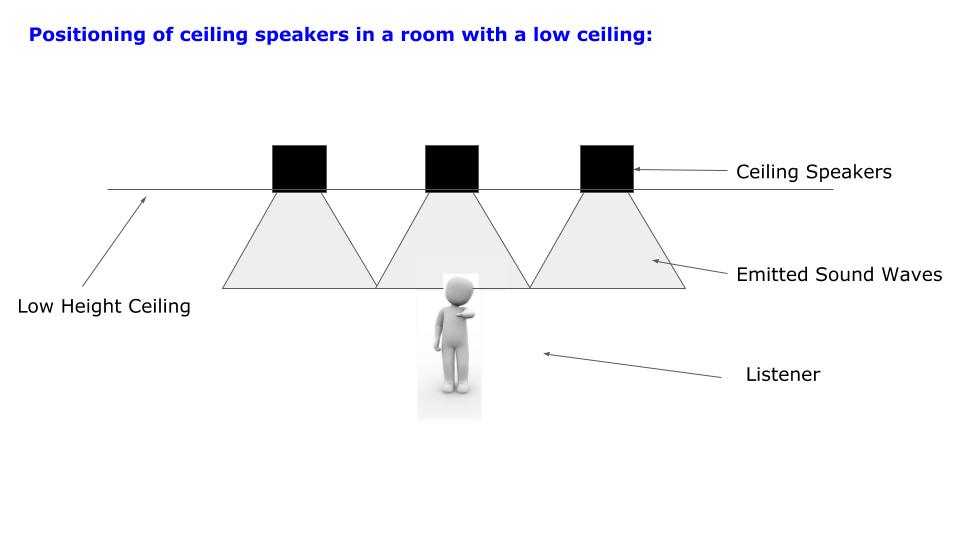
For example, ceiling height has an impact. Counterintuitively, high ceilings often
require fewer speakers than low ceilings, because as a ceiling is lowered, speakers
become closer to a listener’s ears.  So two identically sized rooms with different
ceiling heights will require different numbers of speakers.

“How does that work?”
Each speaker works by emitting waves of sound, these start at the centre of the
speaker cone and radiate outwards towards the floor.  Ideally, to avoid any sound
black-spots, the waves of sound from adjacent speakers should cross just above
a listener’s ear height, but with low ceilings, unless you use a speaker with a much
wider dispersion than normal, the number of speakers you need to achieve this
significantly increases.


“But having lots of speakers makes my ceilings look ugly!”
How many of your guests enter your venue and look up at the ceiling?
Unless you have wonderous artwork or lighting features on the ceiling,
most guests gaze at their eyeline or just above or below this point.
If however, you are concerned about this, CGA can now finish speakers
to any RAL or Pantone colour to ensure that your speaker grills
seamlessly blend into the ceiling whatever its colour.

So the key question to ask is not how can I reduce the number of
ceiling speakers I need, but how many speakers do I need to get the
best possible audio experience for my guests.

CGA Integration … Making hospitality sound great!

Tuesday, 27 November 2018

Sounds Good?

We have moved this content to and added more content on our new website:

www.cga-integration.co.uk


We all talk about “good sound” but what is good sound in a hospitality context?
Good audio is like good visual, it’s very personal and an individual's perception
of quality sound can be very subjective. Having listened to studio recordings of
music tracks, these are very different to the presentation of music that most end
users expect to hear, and with the increased use of mp3 and headphones, the
appreciation of sound is further changing.
That aside, however, there are still some key characteristics that demonstrate
the basis of good sound.

So what should you listen out for?

Good sound should be evenly distributed throughout a space; as guests move
around an area they should receive a consistent audio experience.  Expanding
from this, you should consider your space layout. In adjoining areas where there
is no wall, door or physical barrier, or where the door will be open much of the
time, the sound will travel between adjoining spaces so you need to consider
how zonal sound can be used to create a more consistent experience for your
guests. A great sound system will also envelop you as you enter a space and
the actual sound sources should be hard to define.  This does not mean that
the sound needs to be loud, just seamless. In addition, the sound should be
balanced; there should not be too much or too little bass, mid or high frequency,
(unless of course, you are building a nightclub), and this mix should remain
balanced at both low and high volume levels. Another key area to consider is
where you might need less sound.  You may want lower sound levels in bar
areas and at service points to improve conversation and communication flow
between your customers and your team.

So what are the traps that lead to bad sound and how can these be avoided?
Considering audio hardware, there are certain things that you can do to maximise
the quality of your Hospitality sound.  
Unless you can get wall mounted speakers high above head height, installing these
in big spaces isn’t ideal, as they just make the perimeter of that space louder than
the centre and you don’t create a consistent audio experience.  Similarly, unless you
are on a stage or in a nightclub environment, splitting sound across separate bass
and mid high cabinets can often lead to unbalanced sound and should be avoided.
Using small speakers, although often considered aesthetically pleasing, cannot
supply a warm full sound.  A better alternative is the use of full range speakers,
possibly finished in a custom RAL colour to match your chosen decor, as these
can deliver superior sound whilst blending with your interior design.
Thinking about sound system design, considering the acoustics of a space is
also key in delivering the best possible sound.  Speakers pointing at or across
hard reflective surfaces will not generate good sound. Similarly, sound systems
created with many different areas and speakers but only a few amplifier channels
do not work.  To get great sound, different areas and speakers often need a
different amplifier channel and EQ. Finally, once the system design and hardware
have been considered, the music content needs to be addressed.  Not just what
tracks you are playing to evoke the right mood for your venue or for a particular
time of day, but the type of music format you are using to create the best possible
sound.  The quality at which a track is recorded makes a huge difference to the
end result of how that track sounds when it is played through a sound system.
No matter how good a sound system design and installation is, if you put in poor
quality music you get out louder poor quality music!  Conversely, with a well
designed and installed audio system, if you put in well-recorded music you get
out great sounding music.
To help with this and to avoid any of the legal copyright issues, look to professionally
curated music lists and fit these in a player.  This prevents your staff from putting on
their favourite tracks or from plugging in their phones which will help you to avoid
both legal and branding pitfalls.

So to make a hospitality venue sound good, good sound needs to make a sensory
engagement with your guests, and this can be achieved by the audio being an
integral part of the design, decor and planning of a new or refurbished space.

Monday, 5 December 2016

Rejuvenate your spa with a rich audio tapestry

We have moved this content to and added more content on our new website:

www.cga-integration.co.uk


Creating the right soundscape in your spa
Whether you are considering rejuvenating your spa in the New Year or adding a spa to your hotel to enhance your overall guest experience, don’t underestimate the power of audio in creating the ultimate spa experience.

When we think of spas we conjure up images of tranquility and relaxation.  Spas give us the opportunity to escape, however briefly, from the stresses of everyday life; offering us a chance to recharge and reinvigorate our bodies and minds.  They are havens of peace and relaxation amongst an ever increasingly hectic world; somewhere we can relax without phones ringing, the noise of traffic or the slamming of doors.  

So as you plan to create and build, or refurbish your spa, it is vital to examine all the sources of sound in the area.  You need to consider not only what music you should play, but how your chosen furnishings and infrastructure will affect the sounds created within your spa and what sounds you want to cultivate to create the right ambience for your spa’s guests.

Sound can so often be overlooked, but during treatments when lights are dimmed and guests often close their eyes, other senses including hearing become heightened, so audio replaces colour and becomes a key factor in generating the most appropriate mood.

Eliminating the noise
There are many unwanted sounds which need to be removed or reduced in a spa environment.  The sound of slamming doors, loud footsteps along corridors, phones & pagers ringing, passing traffic, internal plant & machinery noises or sound from other treatment spaces and other parts of your business.  All these noises need to be diminished and replaced with a localised quality audio system.

If you are building a new spa or adding a spa within an existing space, the first thing CGA Integration would recommend is engaging an acoustic environment consultant, (such as the Acoustics & Noise Partnership).  

The acoustic environment consultant will measure the existing noise within the space designated for your spa.  They will then advise you on how to mount internal noise generating electrical hardware and motorised equipment, (such as air conditioners and lifts motors), to minimise noise and how to construct walls of the right density to minimise ‘audio bleed’ between areas.  Little details such as adding the right door closers and seals make a huge difference; minimising the seepage of sound through doors or reducing the noise doors make whilst closing.  

Like rubbing all the markings off a picture to start again with a blank canvas, the more sound you can prevent from entering your spa or from moving between discrete spaces within your spa, the quieter your environment will be.  This makes it easier to create the soundscape you want, rather than having to work around what is already there.

Painting the right picture
Once you have your blank canvas, think about who needs to listen to sound when and why.  Should the audio be in the background or truly a large part of creating the guest experience?

Sound can help to create the right ambience in lounges and communal areas of your spa; transporting your guests to a place of calm tranquility.  Within treatment rooms the audio needs to reflect and enhance the mood of specific treatments, fully immersing the guest in that individual experience.

Historically sound has not always been carefully thought through in spas.  Often guests could be subjected to ‘Whale Music’ whatever their chosen treatment, but now guests are far more savvy and expect more.

Research has shown that sound that is ‘undefined’ can create a bad experience for guests whatever the occasion.  In addition, audio which is too bass heavy will not create the right mood for a spa and similarly, sound which is too sharp and heavy in mid & high frequencies is equally not relaxing.

Today we often have good audio all around us; in our cars, on portable music players and at home with television and home cinema surround sound.  Your clients will know if the sound in your spa is poor. Sound should be full and balanced with a relaxing warmth to the low end but not a disco bass. Using good quality full range speakers can work with the correct back end system, or if the design is sensitive, smaller speakers can be fitted with strategically placed bass units to fill out the sound.  However, care always has to be taken when mounting bass units to prevent sound transmission to other discrete spaces.

It is important to think about where your guests will be when they are listening.  If they are lying down during treatments the ideal position for speakers should actually be at ear height either side of the treatment room to give a true stereo experience.

Equally why not add to the swimming experience by installing underwater speakers?  Although these are now part of the specification for olympic pools, this is not currently the case for leisure pools and the correct music underwater can be a real talking point. As sound travels better through water than through the air, your guest will be able to ‘hear’ the sound through vibrations, without even putting their heads under the water!

Achieving the right results
To help to create the perfect experience in your spa your audio needs to be flexible.  Your staff should have access to a range of music sources to reflect and complement the different treatments and type of trading on offer. CGA Integration recommend that each of the following areas should have their own identity and you should work with your music provider to ensure that each area is a discrete part of your audio design:
  1. Reception area and lounge
  2. Treatment rooms
  3. Manicure / Pedicure area
  4. Pool
  5. Cafe or spatisserie

In addition, some spas offer sockets in treatment rooms to allow their guests to bring their own music.  This can work with a guest that has thought through their music choices, but please bear in mind that allowing your guest to choose their own music  does reduce your ability to enhance the chosen treatment and reinforce your Brand identity.

Once the correct music sources are in place, it is vital to ensure that all volume and audio source controls are placed local to the speakers.  It is paramount that your staff can actually hear the audio they are controlling.  This ensures that sound levels are correct for the trading and or treatment conditions, without the need for guessing and negating the requirement to use internal phones.

Integrating audio with design
Most of the switched on design companies now routinely consider AV as part of spa design.  They will be keen to engage an AV specialist, such as CGA Integration, as early as possible within the design process, to ensure that they deliver a great experience for both you and your guests.

Today speakers come in a huge range of sizes and shapes and can be finished in RAL colours to match your chosen design scheme.  Please bear in mind however, that the smaller the speaker the less bass and warmth it will deliver, so the more likely you will be to require a bass unit. In addition, CGA Integration can deliver fully invisible speakers which can be plastered into ceilings or walls or built into wooden paneling to give a surrounding sound without any visual impact.

Introducing SPAshell
There are many considerations for a hotel operator to appraise when thinking about a traditional build spa, not to mention construction noise and disruption to your existing business. In addition, it is essential to monitor the building process carefully to ensure standards.  One builder not filling a wall void or drilling a hole in the wrong place can lead to noise seepage in your spa and result in time and expense spent locating and resolving the subsequent sound issues. 
This is where SPAshell may well be the right solution for you. Recently CGA Integration have worked closely with Spa Creators to create the audio for their unique concept SPAShell; a modular spa solution which is built off site and then delivered to your venue and set up to trade within 10 days. SPAshell greatly reduces building noise and disruption at your venue and ensures that the spa structure is audibly sound, as it has been designed and manufactured to the high standards and specification by Spa Creators. Alistair Johnson Managing Director said ‘ we were very pleased with the CGA’s expertise in delivering the sound solution for SPAshell, which was not only creative but also very effective”


Whether you need to give your existing spa a new lease of life, or create a new spa offering at your venue, don’t forget the importance of sound in creating the best possible spa experience for your guests.

Monday, 26 September 2016

Is that music to their ears?

We have moved this content to and added more content on our new website:

www.cga-integration.co.uk


The missing piece in the Brand experience puzzle is so often the audio.  It’s easy to see the beautiful interiors our customers will observe and feel, assess the level of customer service they will experience, taste and smell the cuisine and wine they will order, but so very often, what they hear is just overlooked or added as an afterthought.  To deliver a truly memorable experience, audio has to be weaved seamlessly into the sensory mix to create a coherent, holistic result.

Whether you are targeting millennials or any other key market sector, it is becoming more and more important to deliver a coherent and quality soundtrack to each and every experience.  But getting the audio right is not just about delivering the right soundtrack but it's also about using the correct hardware for your space.  Great music delivered through the wrong speakers will always sound bad, however carefully picked the playlist is.  A sound system which has been expertly designed specifically for your requirements and space, using carefully chosen hardware, will always show off the music you have chosen to its very best.

There is a growing body of evidence which supports the fact that audio affects your mood and emotions and as such can change the way in which you react and behave. Our brains receive so many subtle cues from what our ears pick up, that a great deal of our conscious and unconscious moods and behaviour are attributable to what we hear.  Audio is a critical strand in determining how our customers will feel when they experience a venue, not just at the time, but for many years to come, as music is also a powerful tool in evoking memories.

It’s not just about what is played, but also the way in which we hear it which can affect us emotionally. When we listen to warm rich sound with depth and clarity, it can envelop you with feelings of opulence and quality, like sinking into a big comfortable chair from which you don’t want to get up. Conversely, sound that is thin, scratchy and sharp is irritating and something you wish to shut out and move away from as quickly as possible.  So getting the delivery of the soundtrack in your venue right is just as crucial as getting the soundtrack itself right.

When we hear songs from the past they can stir powerful emotions and transport us back in time. Like stepping into a time machine; you can feel everything as if you were actually there. The relationship between music and memory is powerful, all the more reason to get the right associations for your venue, delivered in the right way, to ensure that wonderful memories continue to to be conjured up in the minds of your customers for years to come.

As you seek to differentiate yourself and the experiences you offer, ask yourself; how are we delivering the soundtrack to our guest’s experience?  The greatest interior design, lighting scheme and legendary customer service, whilst crucial, cannot counteract the bad memories created or the negative, uncomfortable feelings generated from a poor soundscape.

Make sure that the audio experience you offer your guests really is music to their ears.