Showing posts with label music. Show all posts

Saturday, 27 March 2021

Let’s go outside …

We have moved this content to and added more content on our new website:

www.cga-integration.co.uk


 As Hospitality gradually reopens, one area that will be key to success, at least in the short to medium term, will be ensuring that venues make the most of their outside spaces by really integrating the ‘outside in.’ 

We now know that good ventilation is key in reducing the spread of Covid, so eating or socialising outside with all the benefits of natural air flow, reduces the propensity of transmission. As a result, outdoor hospitality spaces are going to be key this summer and AV can be used to help enhance your guest’s experience whether they are inside or out.  

Used effectively, a soundscape can bring the ambience of your venue seamlessly from one area to another, to create a holistic experience.  In just the same way as you would use a multi zoned sound system to create continuity of sound, as a guest walks through a hotel from the lobby to the bar though to the restaurant, the right number and type of speakers placed in the correct location can create a seamless flow of sound into an outdoor dining or bar area.

Similarly, outdoor speakers don’t have to be ugly!  Discrete speakers can be installed outside and even matched to a RAL colour to seamlessly blend with your decor.  They can be linked to your existing sound system and controlled in the same way as any other room or zone in your venue, ensuring that the right ambience is created in that area, depending on the occasion or time of day.

So as we embark on the road map to recovery, ‘let’s go outside’ and welcome guests back to our hospitality venues.

CGA Integration … Making hospitality sound great!


Friday, 6 December 2019

Don’t forget your most important resource… your Team!

We have moved this content to and added more content on our new website:

www.cga-integration.co.uk


Motivating your team through their working environment is a key way to help drive your customer’s guest experience. In the hospitality industry, it is always vital that we deliver exceptional customer service to reinforce our Brand values and hopefully ensure repeat business. Obviously the look, ambience and technology infrastructure of a venue is key in delivering this, but it is the staff that work at the venue that are paramount in ensuring that your guests stay is a memorable one, for all the right reasons! Valuing and motivating staff comes in many guises; pay, benefits, empowerment, promotional prospects, but working conditions are also key. Ensuring that care is taken over the environment for your staff areas, as well as those for your guests, will help your staff to feel valued and in turn help them to ‘live your Brand’. Improving Back of House Areas using AV Increasingly CGA Integration is seeing savvy employers investing in their staff areas; using AV technology to enhance ‘Back of House.’ Over the years, CGA has installed sound systems and digital signage in staff areas at venues such as The Dorchester, Park Lane and the staff canteen at Hyatt Regency London - The Churchill. We have also worked with partners to install digital signage back of house in hotels, to ensure that their staff arrive and leave work in a pleasant environment and are kept up to speed with staff news and current affairs. Back of House Sound Systems Installing sound systems throughout staff changing areas and back of house areas will help staff to feel relaxed when starting and leaving work. Some venues use soothing music, while others choose local radio stations with news, to ensure that the staff are up to speed with what is happening locally, benefiting both them and in turn your guests. Back of House Digital Signage Gone are the days of paper bulletins to inform staff of important news and key staff events, email has taken over, but at times where your staff might not have access to their mobile phone or computer, digital signage, (a generic term for information disseminated through electronic screens), can be used in staff areas to keep them up to speed. Venues are using this to inform staff of; important corporate news, key employee information and more crucially staff social events and activities, even to wish employees a Happy Birthday! Many employers are very conscientious in differentiating between corporate and staff information to ensure that members of staff feel their events are social occasions. The way digital signage is presented can help with this differentiation. Help your team to live your Brand Creating a back of house environment that is synonymous with your Brand, one which is inclusive to the longest serving and newest arrival alike, will help your staff in turn better deliver your Brand to your customers, selling and upselling products much more effectively than brochures or websites alone. If you think this is an area that your hotel could benefit from then please do get in touch to discuss how AV can be used to empower your most important resource … your team. I look forward to hearing from you. Chris Gunton Managing Director CGA Integration

CGA Integration … Making hospitality sound great!

Wednesday, 3 April 2019

Size is not everything!

We have moved this content to and added more content on our new website:

www.cga-integration.co.uk


“Wow look at that speaker! We’re not a nightclub!!!”

I have heard this and similar comments time and again when designing a sound
system for a client for the first time.  A regular misconception is that the physical
size of a speaker is directly proportional to the volume or loudness of the sound
system, but that is generally not the case.

It’s true that you will need larger speakers to produce sound for a live concert
than you would need to install in a restaurant, but as sound gets quieter, there
is a minimum speaker size that you will reach, after which you start
compromising on sound quality.

Sound reproduction is all about moving air particles or vibrations.  In a
loudspeaker an electromagnet is attached to a cone which amplifies these
vibrations as it moves forwards and backwards, making sound waves in the
surrounding air and pumping them towards your ears.

So how do we hear music which is made up of lots of different sounds? Without
going too deeply into the science behind this, the frequency of the vibrations
(the number of sound waves that go past a fixed point say every second)
governs the pitch of the sound produced.  To faithfully reproduce all the
different frequencies of sound in a piece of music, good quality speakers use
different sized cones dedicated to high, medium and low frequencies, hence
the need for a minimum sized speaker to accommodate these. Generally in
each speaker cabinet there will be a bass driver (for low frequency sound
waves) and tweeter (for high frequency sound waves) and these will ensure
that sound from all frequencies is covered.

High frequency sound waves generate small movements of a small loudspeaker
surface area (the smaller tweeter cone) and lower frequency sound generate
large movements of a large surface area (the larger bass driver cone).  Basically
the lower the pitch of the sounds you want to replicate, the larger the surface
area of the cone and the larger the cubic volume of the speaker box you will need.

Sound volume (measured in decibels) is actually down to the amplitude of the
sound waves.  The amplitude of a sound wave (or the maximum distance moved),
is a reflection of how much energy it carries, the more energy it has the more air
particles that are moved for longer and the greater the sound we hear.

So, if you want a warm and full sound system throughout all the areas of your
venue, then you will need to have enough surface area of loudspeakers to excite
the air in the space and enough cubic volume of speaker cabinets to enable a
warm and comfortable sound to be generated in all areas.  This will be delivered
through a combination of; the right number of speakers of the right size installed
in the right locations.

Here at CGA Integration we generally use the smallest speaker cabinet required
to deliver a good full range sound in the required space, often in many multiples
to ensure that the distance from the customer to the speakers remains as
constant as possible as they move around the space.  This is explained in
Here you will find lots of articles dealing with speaker solutions including
“design led sound solutions” where we explain how to minimise the visual impact
of speakers whilst still generating superior sound & “speaker location; a sound delivery”
which considers the different types of speakers available and where they can be
installed for maximum audio effect.

To sum everything up, if speakers are too small or too few are used, this can
lead to issues in sound reproduction and quality, which will affect the
ambience of your venue.  Just remember, your AV design is created that way
or a reason, as “you cannot change the laws of physics!”

Friday, 1 February 2019

Why so many speakers!?

We have moved this content to and added more content on our new website:

www.cga-integration.co.uk


“Why do we need so many speakers?”
This is one of the most regular questions we get asked by clients.  The answer is
that the number of speakers we use in a sound system design depends on both
the acoustics and the layout of a venue, and here at CGA we will only recommend
the optimum number required to deliver the best possible audio experience; no
more and no less.

Sound should be like great design and should envelop and surround you from the
moment you enter a room. Visually, great interior design flows through a venue
and demonstrates the careful thought put into creating a flawless experience for
your guests.  Audibly, a well-installed quality sound system will do the same. With
the right number of speakers it will not be too loud or have audio ‘blackspots’, but
the audio will be present equally across all areas and will be a key component of
the overall sensory experience in your venue.

“But why does my venue appear to have more speakers than others?”
Calculating the number of speakers needed by comparing venues of a similar size
will not always work, as acoustics play a key role in determining speaker numbers.
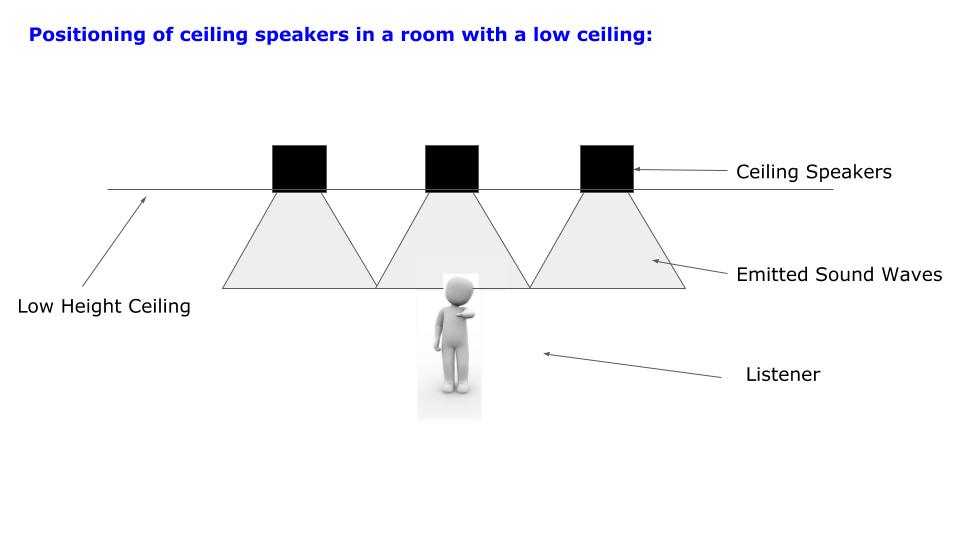
For example, ceiling height has an impact. Counterintuitively, high ceilings often
require fewer speakers than low ceilings, because as a ceiling is lowered, speakers
become closer to a listener’s ears.  So two identically sized rooms with different
ceiling heights will require different numbers of speakers.

“How does that work?”
Each speaker works by emitting waves of sound, these start at the centre of the
speaker cone and radiate outwards towards the floor.  Ideally, to avoid any sound
black-spots, the waves of sound from adjacent speakers should cross just above
a listener’s ear height, but with low ceilings, unless you use a speaker with a much
wider dispersion than normal, the number of speakers you need to achieve this
significantly increases.


“But having lots of speakers makes my ceilings look ugly!”
How many of your guests enter your venue and look up at the ceiling?
Unless you have wonderous artwork or lighting features on the ceiling,
most guests gaze at their eyeline or just above or below this point.
If however, you are concerned about this, CGA can now finish speakers
to any RAL or Pantone colour to ensure that your speaker grills
seamlessly blend into the ceiling whatever its colour.

So the key question to ask is not how can I reduce the number of
ceiling speakers I need, but how many speakers do I need to get the
best possible audio experience for my guests.

CGA Integration … Making hospitality sound great!

Tuesday, 27 November 2018

Sounds Good?

We have moved this content to and added more content on our new website:

www.cga-integration.co.uk


We all talk about “good sound” but what is good sound in a hospitality context?
Good audio is like good visual, it’s very personal and an individual's perception
of quality sound can be very subjective. Having listened to studio recordings of
music tracks, these are very different to the presentation of music that most end
users expect to hear, and with the increased use of mp3 and headphones, the
appreciation of sound is further changing.
That aside, however, there are still some key characteristics that demonstrate
the basis of good sound.

So what should you listen out for?

Good sound should be evenly distributed throughout a space; as guests move
around an area they should receive a consistent audio experience.  Expanding
from this, you should consider your space layout. In adjoining areas where there
is no wall, door or physical barrier, or where the door will be open much of the
time, the sound will travel between adjoining spaces so you need to consider
how zonal sound can be used to create a more consistent experience for your
guests. A great sound system will also envelop you as you enter a space and
the actual sound sources should be hard to define.  This does not mean that
the sound needs to be loud, just seamless. In addition, the sound should be
balanced; there should not be too much or too little bass, mid or high frequency,
(unless of course, you are building a nightclub), and this mix should remain
balanced at both low and high volume levels. Another key area to consider is
where you might need less sound.  You may want lower sound levels in bar
areas and at service points to improve conversation and communication flow
between your customers and your team.

So what are the traps that lead to bad sound and how can these be avoided?
Considering audio hardware, there are certain things that you can do to maximise
the quality of your Hospitality sound.  
Unless you can get wall mounted speakers high above head height, installing these
in big spaces isn’t ideal, as they just make the perimeter of that space louder than
the centre and you don’t create a consistent audio experience.  Similarly, unless you
are on a stage or in a nightclub environment, splitting sound across separate bass
and mid high cabinets can often lead to unbalanced sound and should be avoided.
Using small speakers, although often considered aesthetically pleasing, cannot
supply a warm full sound.  A better alternative is the use of full range speakers,
possibly finished in a custom RAL colour to match your chosen decor, as these
can deliver superior sound whilst blending with your interior design.
Thinking about sound system design, considering the acoustics of a space is
also key in delivering the best possible sound.  Speakers pointing at or across
hard reflective surfaces will not generate good sound. Similarly, sound systems
created with many different areas and speakers but only a few amplifier channels
do not work.  To get great sound, different areas and speakers often need a
different amplifier channel and EQ. Finally, once the system design and hardware
have been considered, the music content needs to be addressed.  Not just what
tracks you are playing to evoke the right mood for your venue or for a particular
time of day, but the type of music format you are using to create the best possible
sound.  The quality at which a track is recorded makes a huge difference to the
end result of how that track sounds when it is played through a sound system.
No matter how good a sound system design and installation is, if you put in poor
quality music you get out louder poor quality music!  Conversely, with a well
designed and installed audio system, if you put in well-recorded music you get
out great sounding music.
To help with this and to avoid any of the legal copyright issues, look to professionally
curated music lists and fit these in a player.  This prevents your staff from putting on
their favourite tracks or from plugging in their phones which will help you to avoid
both legal and branding pitfalls.

So to make a hospitality venue sound good, good sound needs to make a sensory
engagement with your guests, and this can be achieved by the audio being an
integral part of the design, decor and planning of a new or refurbished space.

Tuesday, 25 September 2018

Design Led Sound Solutions from CGA Integration

We have moved this content to and added more content on our new website:

www.cga-integration.co.uk


Holistic visual design

Have you ever been frustrated that your interior design is being compromised by the functional requirements of services? Do you have an eyesore of a white grill on a coloured ceiling, black boxes on white walls or maybe too many controls on the walls, with staff unable to get the consistency you planned and designed for?

If this sounds like an experience you are all too familiar with, CGA Integration can help you to address these aesthetic issues, whilst still enabling you to deliver the functional design that your client’s venue demands.

CGA can deliver speakers and grills resprayed to any RAL colour to ensure the integrity demands of your design, even after the services have been installed. With this available from CGA for all services, not just for sound equipment, we can help you to deliver a truly holistic visual design.

In addition, the control systems that CGA deploy not only deliver great sound but can also control; lighting, video, blinds, air conditioning and a whole range of other services. This enables you, the designer, to deliver a control platform for the whole environment, rather than creating a wall full of buttons to control varying parts of it!

So rather than planning how to layout a wall of switches, let us help you to change the conversation to talk about integration in the plant rooms and colours and fonts for the iPad control screens.

Addressing the soundscape
Taking things one step further, designs that encompass all the senses create a truly holistic guest experience. Although the visual design creates a wonderful first impression, hearing is one of our primary fight and flight senses; get the sound wrong in a venue and guests may never be comfortable in the space, no matter how wonderful it looks!

To generate the best sound, you need to ensure that the correct speakers and reproductive equipment are installed for the space. Not every sound system will deliver the right sound. How you hear sound in a space changes considerably with decorative finishes and also once it is occupied. CGA can help by creating the best sound system for your space, choosing and fitting the right equipment to deliver what your client needs it to do, throughout the day, every day.

Designed for the future 
Once you know that your design will both look and sound how you envisaged, how do you ensure that it stays that way, whilst still allowing flexibility and future proofing for your client?

Here at CGA we always plan for the future. With every sound system we create, we ensure spare cable runs to allow for changes to systems without the need for rewiring and we install digital control platforms which allow equipment to be monitored and tested by us remotely, (in real time), to ensure that all hardware is at it’s best at all times. These same digital control systems also allow systems to be reconfigured and reprogrammed easily with no hardware changes to repurpose or refresh a space for added peace of mind.

Why not talk to us about getting the sound system right for the space you are designing for. This might just add that final edge to your design; keeping your client’s guest’s spending and your client coming back to you for more great designs.

CGA Integration … Making hospitality sound great!

Tuesday, 24 July 2018

Why do I need PPL and PRS and what do they do?

We have moved this content to and added more content on our new website:

www.cga-integration.co.uk


PPL and PRS for Music are the UK's two music licensing societies.

PPL represents performers and record companies. PRS for Music is
a society of songwriters, composers and music publishers. Both
organisations ensure that the creators and performers of music are
paid when their music is used in public.

PPL PRS Ltd is a new joint venture between PPL and PRS for Music.
They have recently joined forces to make it easier for their customers
to obtain a music licence for the playing or performance of music in public.  

The purpose of PPL PRS Ltd is to ensure that writers and performers are
fairly rewarded for their talent, but also to support those who use music
on a daily basis.

What is TheMusicLicence?

TheMusicLicence allows you to legally play and perform music in your
business, whether through the radio, TV, other devices and or through
live performances.

If you play or perform music in your business or organisation in the UK,
you will usually need TheMusicLicence. It will cover you, with one licence
and one invoice, for the use of virtually all commercially released music
available; millions of songs and recordings, including the most popular
and well-loved music not just from the UK but also from around the world.

Can I play Spotify or Apple Music in my Business?

The simple answer is no. In business terms, music streaming services
come in two forms; B2C (Business to Consumer) and B2B (Business to
Business). The core music streaming services offered by companies like
Spotify and Apple Music are B2C built for consumers, not businesses.
This means they are licensed for private, non-commercial use (perfect
to use at home with your friends & family). You need to purchase
TheMusicLicence to play music in public places, including to your
customers and employees.

But I have purchased iTunes Music so surely I can play this?

It is common in our digital age to be confused as to whether we own our
digital content. When you pay to download music or even movies for
that matter, you are essentially purchasing a license; you are leasing the content. Furthermore, you may only play this music in a non-commercial setting. You can listen to the songs yourself as much as you like, but it is illegal to play them in public. iTunes music on your iPod, iPad, iPhone, CDs, MP3s or digital files can not be used for background music in a commercial environment. Playing the downloaded music in your business violates copyright law because the act is now considered a public performance.
Public performances require TheMusicLicence.

What are Professional Creative Music Agencies?

Professional Creative Music Agencies create playlists of tracks to create
unique atmospheres and distinct brand identities for their clients.  All
music chosen by these agencies is covered by TheMusicLicence.
CGA Integration always recommends using this service, as you have
the peace of mind that when you purchase TheMusicLicence, all of your playlist will be covered. You also have the added benefit that the perfect playlist has been created specifically for your business.

Monday, 12 June 2017

Come in, relax and make yourself at home …

We have moved this content to and added more content on our new website:

www.cga-integration.co.uk


Sound; the missing link in the sensory jigsaw:
Come in, relax and make yourself at home … how would you like your guests to feel when they think about visiting your venue?

In the Hospitality Industry we are all searching to make people feel as welcome and relaxed as possible.  Venues invest in exquisite decor, beautifully designed lighting schemes and specially selected staff, carefully trained to deliver outstanding customer service, but do you still find that not everyone can truly relax?  Some guests can remain on edge throughout their stay and fail to immerse themselves in the wonderful environment created around them.

Maybe sound is the missing link in the sensory jigsaw, the subconscious trigger in helping all your guests to truly relax.

Our hearing is so often the sense we take for granted.  Sound tends to just happen around us.  Familiar noises such as aeroplanes flying overhead, phones ringing, vacuum cleaners whirring, birds singing, children playing or people walking by, just become background noise.  It's often not until you stop and really listen that you can pick out each of these individual sounds.

Our bodies are in a neutral state around sounds that we are use to hearing, but if we are placed in an unfamiliar environment or situation with noises that we are not use to, our sense of hearing becomes heightened and our body becomes generally more alert.  This biological reaction links back to our inbuilt “Fight or Flight” response, which is designed to keep us safe.  As cavemen, our ancestors faced the regular question “should we stay and ward off this prehistoric predator or run as fast as we can to get away from it?”  Thankfully, we no longer generally face this kind of dilemma on a daily basis, but the inbuilt “Fight or Flight” response remains hard wired into our psyche.

Silence and sudden loud noises can often affect us in a similar way.  If we consider the natural world for a moment, predators are often met with an ‘alarm’ call to warn others in their group of impending danger and potentially scare off the intruder, in much the same way as the modern equivalent of a smoke detector, house or car alarm.  Conversely, potential prey can often remain still and silent to conceal their presence from a predator, which in turn heightens their other senses and prepares their bodies for ‘flight’.  These inbuilt behaviours remain part of us even today, so getting sound right for your guests is a crucial part in helping them to truly relax, even though they might not be able to tell you why!

Getting it right:
So how do you get it right?  This is not just about sound for sound’s sake, but about using sound in the right way to help change your guest’s opinions, from liking your venue into really loving it.

By eliminating unwanted noises, choosing a soundtrack to complement your Brand and delivering this through a well designed, expertly installed, flexible sound system, you can address the missing link in the sensory jigsaw.  This removes areas of silence, helps to reduce the inbuilt “Fight or Flight” response in us all and joins together all the other sensory messages experienced by your guests enabling them to truly relax.

Eliminating unwanted noises and reduce noise reflection:
Before you start adding sound to a space you need to consider noises which already exist or which can be heard from within that space, which might have a detrimental effect on your guests, for example noise from; traffic, open kitchens, doors slamming or phones ringing.  Ideally all these noises need to be diminished.

Stand and clap your hands in the space, think about how every noise will or will not be reflected throughout that area, if necessary add some sound absorbing surfaces to deaden these reflections so that you have as blank an acoustic canvas as possible to start painting your soundscape on.  To help, you can engage an acoustic environment consultant to measure the existing noise within the space.  They will then advise you on how to minimise noise and ‘audio bleed’ from other areas.

Choosing a soundtrack to complement your Brand:
Work with a music provider to ensure that the music you are playing complements and enhances your Brand.  Who are your guests? Does your offer change throughout the day? Indeed does your customer demographic change throughout the day? Your music content choice needs to reflect all of these variables.

A well designed, expertly installed, flexible sound system:
To generate the best sound, you need to ensure that the correct speakers and reproductive equipment are installed for your space.  Not every sound system will deliver the right sound. How you hear sound in a space changes considerably with decorative finishes and also once it is occupied.  A specialist sound system designer and installer will create the best sound system for your space, choosing and fitting the right equipment to deliver what you need it to do throughout the day, every day.

Once you have worked through the issue of unwanted noise & sound reflection and chosen the right music content, you may well find that the amount of music you have to add to a space is vastly reduced, as you are no longer competing with or trying to mask other sounds.

To find out if sound really is the missing link in your venue’s sensory jigsaw why not contact CGA Integration today and arrange a full AV review.  Help your guests to immerse themselves in your hospitality experience and truly relax.