Showing posts with label venue. Show all posts

Wednesday, 3 April 2019

Size is not everything!

We have moved this content to and added more content on our new website:

www.cga-integration.co.uk


“Wow look at that speaker! We’re not a nightclub!!!”

I have heard this and similar comments time and again when designing a sound
system for a client for the first time.  A regular misconception is that the physical
size of a speaker is directly proportional to the volume or loudness of the sound
system, but that is generally not the case.

It’s true that you will need larger speakers to produce sound for a live concert
than you would need to install in a restaurant, but as sound gets quieter, there
is a minimum speaker size that you will reach, after which you start
compromising on sound quality.

Sound reproduction is all about moving air particles or vibrations.  In a
loudspeaker an electromagnet is attached to a cone which amplifies these
vibrations as it moves forwards and backwards, making sound waves in the
surrounding air and pumping them towards your ears.

So how do we hear music which is made up of lots of different sounds? Without
going too deeply into the science behind this, the frequency of the vibrations
(the number of sound waves that go past a fixed point say every second)
governs the pitch of the sound produced.  To faithfully reproduce all the
different frequencies of sound in a piece of music, good quality speakers use
different sized cones dedicated to high, medium and low frequencies, hence
the need for a minimum sized speaker to accommodate these. Generally in
each speaker cabinet there will be a bass driver (for low frequency sound
waves) and tweeter (for high frequency sound waves) and these will ensure
that sound from all frequencies is covered.

High frequency sound waves generate small movements of a small loudspeaker
surface area (the smaller tweeter cone) and lower frequency sound generate
large movements of a large surface area (the larger bass driver cone).  Basically
the lower the pitch of the sounds you want to replicate, the larger the surface
area of the cone and the larger the cubic volume of the speaker box you will need.

Sound volume (measured in decibels) is actually down to the amplitude of the
sound waves.  The amplitude of a sound wave (or the maximum distance moved),
is a reflection of how much energy it carries, the more energy it has the more air
particles that are moved for longer and the greater the sound we hear.

So, if you want a warm and full sound system throughout all the areas of your
venue, then you will need to have enough surface area of loudspeakers to excite
the air in the space and enough cubic volume of speaker cabinets to enable a
warm and comfortable sound to be generated in all areas.  This will be delivered
through a combination of; the right number of speakers of the right size installed
in the right locations.

Here at CGA Integration we generally use the smallest speaker cabinet required
to deliver a good full range sound in the required space, often in many multiples
to ensure that the distance from the customer to the speakers remains as
constant as possible as they move around the space.  This is explained in
Here you will find lots of articles dealing with speaker solutions including
“design led sound solutions” where we explain how to minimise the visual impact
of speakers whilst still generating superior sound & “speaker location; a sound delivery”
which considers the different types of speakers available and where they can be
installed for maximum audio effect.

To sum everything up, if speakers are too small or too few are used, this can
lead to issues in sound reproduction and quality, which will affect the
ambience of your venue.  Just remember, your AV design is created that way
or a reason, as “you cannot change the laws of physics!”

Friday, 1 February 2019

Why so many speakers!?

We have moved this content to and added more content on our new website:

www.cga-integration.co.uk


“Why do we need so many speakers?”
This is one of the most regular questions we get asked by clients.  The answer is
that the number of speakers we use in a sound system design depends on both
the acoustics and the layout of a venue, and here at CGA we will only recommend
the optimum number required to deliver the best possible audio experience; no
more and no less.

Sound should be like great design and should envelop and surround you from the
moment you enter a room. Visually, great interior design flows through a venue
and demonstrates the careful thought put into creating a flawless experience for
your guests.  Audibly, a well-installed quality sound system will do the same. With
the right number of speakers it will not be too loud or have audio ‘blackspots’, but
the audio will be present equally across all areas and will be a key component of
the overall sensory experience in your venue.

“But why does my venue appear to have more speakers than others?”
Calculating the number of speakers needed by comparing venues of a similar size
will not always work, as acoustics play a key role in determining speaker numbers.
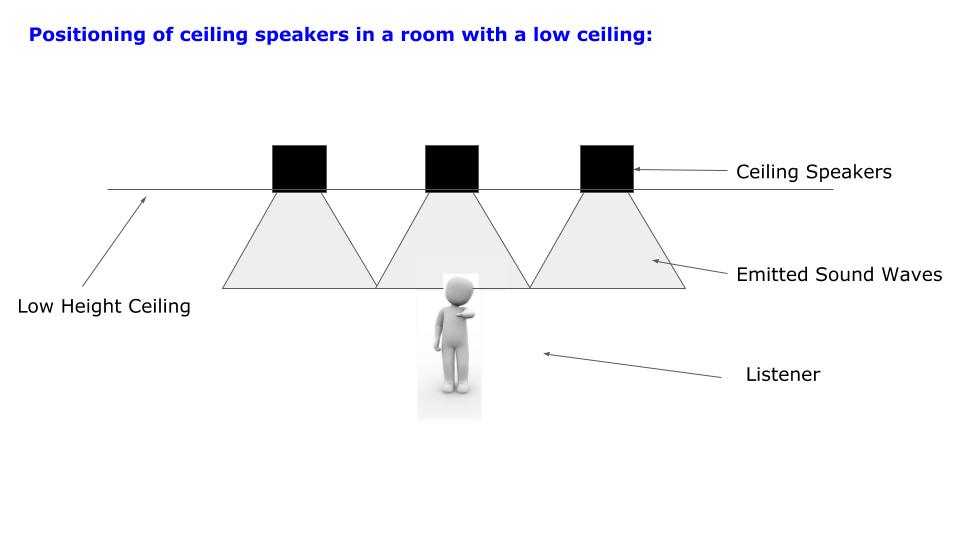
For example, ceiling height has an impact. Counterintuitively, high ceilings often
require fewer speakers than low ceilings, because as a ceiling is lowered, speakers
become closer to a listener’s ears.  So two identically sized rooms with different
ceiling heights will require different numbers of speakers.

“How does that work?”
Each speaker works by emitting waves of sound, these start at the centre of the
speaker cone and radiate outwards towards the floor.  Ideally, to avoid any sound
black-spots, the waves of sound from adjacent speakers should cross just above
a listener’s ear height, but with low ceilings, unless you use a speaker with a much
wider dispersion than normal, the number of speakers you need to achieve this
significantly increases.


“But having lots of speakers makes my ceilings look ugly!”
How many of your guests enter your venue and look up at the ceiling?
Unless you have wonderous artwork or lighting features on the ceiling,
most guests gaze at their eyeline or just above or below this point.
If however, you are concerned about this, CGA can now finish speakers
to any RAL or Pantone colour to ensure that your speaker grills
seamlessly blend into the ceiling whatever its colour.

So the key question to ask is not how can I reduce the number of
ceiling speakers I need, but how many speakers do I need to get the
best possible audio experience for my guests.

CGA Integration … Making hospitality sound great!

Tuesday, 27 November 2018

Sounds Good?

We have moved this content to and added more content on our new website:

www.cga-integration.co.uk


We all talk about “good sound” but what is good sound in a hospitality context?
Good audio is like good visual, it’s very personal and an individual's perception
of quality sound can be very subjective. Having listened to studio recordings of
music tracks, these are very different to the presentation of music that most end
users expect to hear, and with the increased use of mp3 and headphones, the
appreciation of sound is further changing.
That aside, however, there are still some key characteristics that demonstrate
the basis of good sound.

So what should you listen out for?

Good sound should be evenly distributed throughout a space; as guests move
around an area they should receive a consistent audio experience.  Expanding
from this, you should consider your space layout. In adjoining areas where there
is no wall, door or physical barrier, or where the door will be open much of the
time, the sound will travel between adjoining spaces so you need to consider
how zonal sound can be used to create a more consistent experience for your
guests. A great sound system will also envelop you as you enter a space and
the actual sound sources should be hard to define.  This does not mean that
the sound needs to be loud, just seamless. In addition, the sound should be
balanced; there should not be too much or too little bass, mid or high frequency,
(unless of course, you are building a nightclub), and this mix should remain
balanced at both low and high volume levels. Another key area to consider is
where you might need less sound.  You may want lower sound levels in bar
areas and at service points to improve conversation and communication flow
between your customers and your team.

So what are the traps that lead to bad sound and how can these be avoided?
Considering audio hardware, there are certain things that you can do to maximise
the quality of your Hospitality sound.  
Unless you can get wall mounted speakers high above head height, installing these
in big spaces isn’t ideal, as they just make the perimeter of that space louder than
the centre and you don’t create a consistent audio experience.  Similarly, unless you
are on a stage or in a nightclub environment, splitting sound across separate bass
and mid high cabinets can often lead to unbalanced sound and should be avoided.
Using small speakers, although often considered aesthetically pleasing, cannot
supply a warm full sound.  A better alternative is the use of full range speakers,
possibly finished in a custom RAL colour to match your chosen decor, as these
can deliver superior sound whilst blending with your interior design.
Thinking about sound system design, considering the acoustics of a space is
also key in delivering the best possible sound.  Speakers pointing at or across
hard reflective surfaces will not generate good sound. Similarly, sound systems
created with many different areas and speakers but only a few amplifier channels
do not work.  To get great sound, different areas and speakers often need a
different amplifier channel and EQ. Finally, once the system design and hardware
have been considered, the music content needs to be addressed.  Not just what
tracks you are playing to evoke the right mood for your venue or for a particular
time of day, but the type of music format you are using to create the best possible
sound.  The quality at which a track is recorded makes a huge difference to the
end result of how that track sounds when it is played through a sound system.
No matter how good a sound system design and installation is, if you put in poor
quality music you get out louder poor quality music!  Conversely, with a well
designed and installed audio system, if you put in well-recorded music you get
out great sounding music.
To help with this and to avoid any of the legal copyright issues, look to professionally
curated music lists and fit these in a player.  This prevents your staff from putting on
their favourite tracks or from plugging in their phones which will help you to avoid
both legal and branding pitfalls.

So to make a hospitality venue sound good, good sound needs to make a sensory
engagement with your guests, and this can be achieved by the audio being an
integral part of the design, decor and planning of a new or refurbished space.

Monday, 12 February 2018

Fly your way to more events business

We have moved this content to and added more content on our new website:

www.cga-integration.co.uk


CGA met with an Events Manager at a London hotel recently and a worrying statistic
emerged; 30% of potential customers for large-scale functions declined to book their
venue after viewing the ballroom, as there were no flying points.

The actual number of ‘lost clients’ is probably even higher, as many events
companies having previously visited would already know that flying points were
not available, so would not even consider the venue as a potential option in the first
place.

So if you have a good size function space, one which can cater for over 200 guests,
with a good height ceiling and no flying points, then maybe you too are missing out
on a large portion of the available business.

So what is a flying point?
Flying points are in principal big hooks or fixing points fitted to the structure of your
roof or ceiling. They allow events companies to hang equipment without having to
build up from the ground with stands or scaffolding, therefore leaving your events
space looking more like a purpose-built function space. 
A flying point also has the added safety benefit of being rated and tested with a
loading which specifies the weight of equipment that events company can hang or
fly from it.

So why do I need flying points in my events space?
There is a growing trend that companies booking hospitality spaces to host large
scale events are either events companies themselves, or the company making the
booking will be employing an events company to manage the occasion.

The events company will want to bring in speakers, lighting, video screens and
lots of other technology to make the occasion special or even spectacular!  All
of this equipment needs to be mounted, often at a high level, to allow visibility
and sound dispersion throughout the function room to create the desired effects.

Is there anything else I should consider?
If you are considering adding flying points to your events space, you must work
with a structural engineer to ensure that your building is capable of taking the
weight required to be hung.  If this is confirmed, engage a reputable rigging
company to ensure that they correctly install flying equipment in the right place,
with the correct weight loading capability required.

To ensure minimal visual impact, you may also choose to work with an interior
designer to enable that these flying points ‘disappear’ when they are not in use.
Although please remember it is paramount to let the structural engineer & rigging
company agree the location of these points NOT the designer, to ensure the
safety and functionality of the points.

Plan to maintain flying points in your annual budgeting.  As they are essentially
lifting gear, they need to be regularly tested to ensure that they are safe and
compliant with industry standards.

If you are investing in flying points to enable events companies to fly lots of
technology, you equally need to consider power and cable management. Think
about how best to supply a suitable amount of power to the points, some in the
roof space, as well as how the power will be routed from the floor of the venue
up to these flying points without having unsightly bundles of cables swinging around.

If you would like to find out more about installing flying points then please give us
a call on 0845 058 4652, email or maybe take a look at refurbishing your events
space on the CGA website and we can advise you how to start the process to
maximise the effectiveness of your critical events space.

CGA … making hospitality sound Great!

Friday, 24 February 2017

Creating the right soundtrack for weddings

We have moved this content to and added more content on our new website:

www.cga-integration.co.uk


Weddings in the UK are big business, with couples and their parents spending thousands of pounds on their big day.  Organising a wedding is a very stressful event, in surveys it’s up there with death of a loved one, divorce and moving house!  What should be a very joyous occasion, is often overshadowed by all the little details the happy couple need to consider, coordinate and arrange.  

Choosing a venue for both the service and the reception is a key decision for every bride and groom.  Selecting somewhere which offers the right mix of facilities whilst creating the right atmosphere for their big day is paramount.  Music is one of the key strands to run throughout the day, from the arrival of the first guest, to the service, into the reception & wedding breakfast with speeches, to the first dance and into the evening entertainment.  Helping your guests by offering them all the AV facilities they need will make their lives easier and make them more likely to choose your venue over others.

Music is so important.  Helping your guests to create the soundtrack for their special day is a vital part of a successful wedding.  When we hear songs from the past they can stir up powerful emotions and transport us back in time. Like stepping into a time machine; you can feel everything as if you were actually there. The Bride and Groom might want to capture memories from special events at their wedding; music which reminds them of when and where they met, their first date or the proposal.  The relationship between music and memory is powerful, which is all the more reason to get the right associations for every wedding day.  Deliver this in the right way to ensure that wonderful memories of the wedding, at your venue, continue to be conjured up in the minds of the happy couple and their alike guests for many years to come.  

What music and technology do I need to offer my guest?

AV requirements for a wedding will vary throughout the day and will depend on if your venue is licenced to conduct the wedding service as well as hold the reception.  To help you to make sure that nothing gets missed, here is a helpful checklist to ensure that you, and any events companies or DJ’s you may employ, have everything you need to make your guest’s big day sound just how they want it to.

(i) Ceremony music
Many of your Brides and Grooms may choose to bring their own music for their service.  As such you need to let them know what format this needs to be in and ensure that you have a connection point in the main ceremony room to enable them to play pre, post and during ceremony music.  This either needs to be accessible and easily operated by someone in the wedding party, such as an usher, or by a member of your staff if necessary.  If the Bride and Groom opt for live music during the ceremony, you will also need to ensure that you have got microphones or power for instruments available.

In larger rooms a microphone and possibly an induction loop might also be needed to ensure that the registrar can be heard by all the guests.

(ii) Before and after the ceremony
Your Bride and Groom may request that you play their own background music either before or after the ceremony, during any reception drinks and possibly in the dining area where the wedding breakfast is served.  Ideally all these rooms, if there are more than one, should be linked to enable the same music to be played throughout.  This creates the same mood for all the guests, allowing them to all feel part of the same event.

It is possible that the Bride and Groom may request live music to be played after the service during the drinks reception, maybe a piano with or without a vocalist or even a saxophone or string quartet, so again microphones and power for certain instruments might be required in another area. Whatever the music choice, it's important that guests don’t mingle in silence, as it can make people feel uncomfortable, equally the music that they hear needs to be appropriate, and played at a suitable volume, to ensure that it doesn’t overpower their conversation.  


(iii) The Wedding Breakfast
From the toastmaster through to the speeches after dinner, it is key that everyone in the wedding party can hear what is happening during this equally important part of the day.  A good speaker system in your main dining or events space is key to this, you deliver the same quality food & service to all your guests and they should also expect to receive the same quality audio.  

Considering the all important speeches, make sure that everyone can be heard by ensuring that microphones are available if necessary.  Some guests may be hard of hearing or some speakers might be too embarrassed or emotional to really deliver clearly throughout the whole of their speech.  To help everyone, It is always best to have a microphone and suitable speakers on hand so that every guest can hear all of the proceedings and really feel involved in the day.  The best and most aesthetic delivery of sound will always be from an installed ceiling speaker system that is specifically designed to cover that room.   If you do not yet have this facility at your venue and the DJ is to be in the dining room after the wedding breakfast, it might be possible to use the DJ’s speakers for the speeches.  It's worth remembering however that these might not fit with the decor and ambience of the wedding breakfast and the sound will not be best balanced this way.

With the rise of multimedia, do you have a projector and screen to allow the speakers to show the guests any photographs?  From baby photos to selected images from the stag and hen parties, your speakers may want some visual cues to help them deliver their speeches, (and jokes), sharing images and memories.  This may be something that you use an external events company or the DJ for, as many DJs now use video screens to show video clips and pictures, but either way it may well be something that you are asked if you can provide.

Using digital signage can help to direct guests around your function spaces and signpost what is occurring in different areas as well as helping to personalise the event to help to celebrate the day.

(iv) After dinner entertainment
Although a playlist can be very personal and work to create a mood as background music during the drinks reception or the meal, it is very difficult to predict which songs will work well at what times during a party.

As an ex-DJ, I would urge you to encourage your Brides and Grooms to hire a professional DJ or entertainer.  For a DJ, a wedding reception can be one of the hardest gigs, as the audience you have to engage with is truly diverse: from grandchildren to grandparents, ballroom dancers to ravers and everyone in between!  Pleasing everyone and keeping the dancefloor full can be a real challenge, but  when you get it right it's very rewarding.  

A good DJ will be more than someone who just plays a compiled playlist, they should read the crowd and respond to their mood and dancing preferences, cracking appropriate jokes and creating a memorable party atmosphere along the way, which a predefined playlist just cannot achieve. A real professional will mix selected tracks in with the dancing so that it means something to the Bride and Groom and yet the rest of the crowd, who may be too young or too old to remember your special tracks, can still have a great night.

As a venue owner you need to see how you can make the DJ look like part of your venue for the day to come together seamlessly.

In an ideal world you would have the DJ set up prior to the ceremony and reception drinks so that the set up is not seen, although with some venues resetting rooms for dancing after dinner this can be harder to accomplish.  If this is not possible, think about hiding the DJ equipment behind a curtain or screen or even under table cloths so that the turnaround is faster and boxes do not have to be carried through the venue, breaking the mood of the day which everyone has tried so hard to create.

(v) What is better, owning or hiring?
There are certain items, which as a quality venue you should own, to ensure that they are available to offer your guests at all times, but other equipment you may wish to just consider hiring.  The table below should help you to prioritise your choices.

Items
Use
Own?
Facilitate?
Hire?
Speakers in dining & events spaces
Speeches & background music
Yes, this should be a minimum requirement
N/a
N/a
Radio Microphone
Enabling speeches in any location within events spaces
Yes if demand is high enough

If you find the use of this is infrequent then hiring makes sense
Music player socket, input in function space
Play ceremony or pre and post ceremony music
Yes, this socket should be located in a logical place for guests and or staff to connect and play back music
Yes
N/a
DJ equipment or Band equipment
Wedding evening party
No
Yes, allow for the use of power sockets, set up space, limiters, etc
Yes, hire in a professional from an agency or from the Bride and Groom’s personal experience
Screens
Best man's speech, memory images, etc
Yes, if you have enough storage space and regular use of these.  They can also be used as meeting screens.
Yes, allow for power sockets around the venue
Yes, hire from local events or AV providers as and when the need arises.  This allows you to hire a screen appropriate to the size of the event.

(vi) Managing music volume
If wedding guests are also staying at your venue make sure that where possible you place the guests most likely to be disturbed by a noisy DJ at the other end of your venue, put the best man and bridesmaids in the bedrooms over the dancefloor, as they are most likely to need to change or freshen up and are most likely the last to bed! If this is not possible, try to work with the DJ to maintain a sensible noise level.  Limiters can be fitted and the Environmental Health Officer may insist on these, but try to avoid this route if you can as they can create a poor guest experience, causing the sound to cut out just as the party gets going which equally may mean that the DJ will not want to play your venue again! Some sound limiters have a traffic light system, which if managed correctly enable the venue manager and or DJ to see when the music is getting too loud and to take action to address this gradually and in a controlled way without actually killing the ambience of the evening.

By considering all of this you really should be well on the way to helping your prospective Brides and Grooms create the perfect soundtrack to their wedding.  With music being so closely linked to evoking memories, getting it right through for your guests will mean that you can create the very best memories of their special day at your venue.

For further information about AV equipment and installations for weddings and all other events please call CGA Integration to discuss how to make the most of your venue.